

In the world of architecture, buildings are realised through drawings. These drawings are more than just lines, planes, and dimensions. They are a conversation: between architect and builder; between concept and construction; between idea and reality. And in all of this, one silent yet essential language persists: the lettering. The precise, measured way architects write on their plans and blueprints, architectural lettering,is a discipline in its own right. To understand how it evolved is to understand how architects have sought clarity, consistency, and human touch in the mechanics of design.
The Rise of the Drafting Board
In the early 20th century, formal architectural education often included lettering as a core skill. Before rotary plotters or computers, someone had to write every note, every dimension, every label by hand. In training, students would often spend hours repeating a single phrase or set of letters, striving for consistency of height, stroke weight, and spacing. They used tools: T-squares, parallel rules, triangles; soft pencil for guidelines; harder pencil or technical pens for final lettering. Manuals on architectural drawing and lettering existed, laying out what makes “good” lettering: uniform stroke width, simple shapes, minimal ornament, limitation to capital letters (or capital-like forms) so letters are more uniform and easier to read.
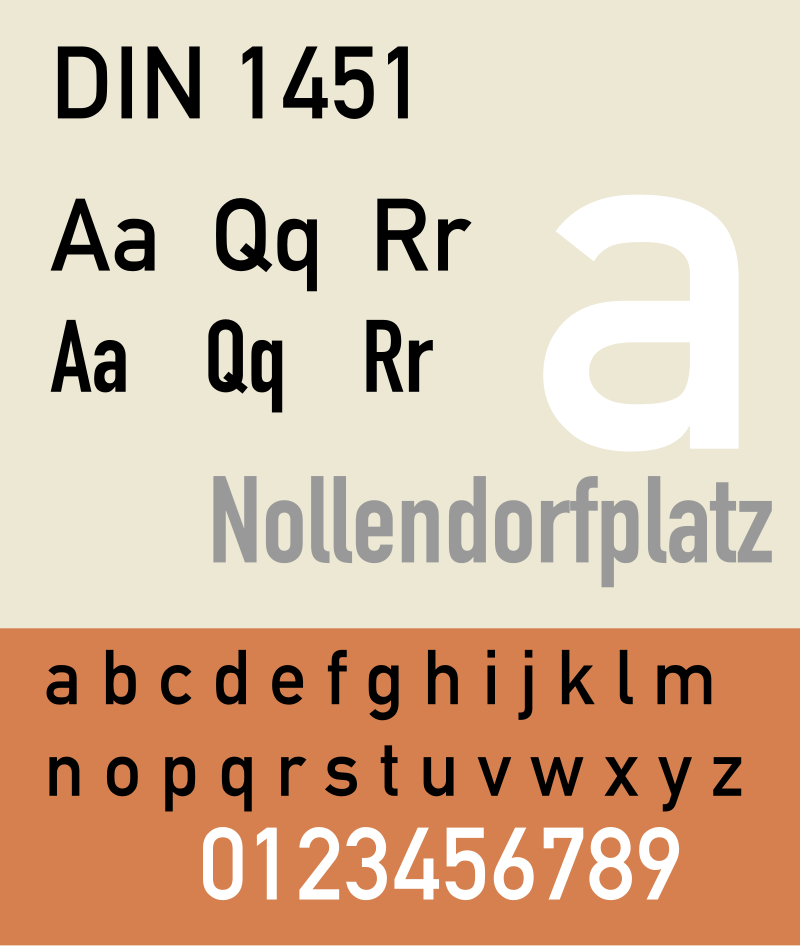
One tool that tipped over from informal use to formal standard is DIN 1451. Introduced in Germany in the early 20th century, DIN 1451 defined a style of sans serif, linear lettering (called “linear Antiqua without serifs”) for technical uses, signage, administrative uses. It laid down rules for how letters should be drawn, what proportions to use. Because it was standardized, it could be used across many drawings, many disciplines, many users, and still be legible and consistent.
Mechanization, Templates, and the Semi-Digital Age
As the demand for drawings grew, speed and reproducibility became more important. Hand-lettering, though elegant, was slow and subject to human inconsistency. Tools evolved to ease the burden.
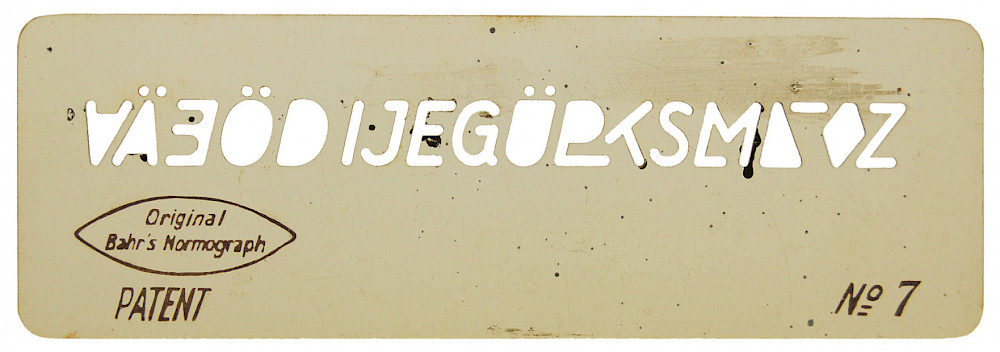
Lettering templates, both plastic or metal cut-outs of letterforms, allowed drafters to trace shapes rather than draw them free hand. Normographs offered sets of arcs, curves, straightings, repeated shapes to standardize frequent forms. Drafting machines and specialized drawing boards allowed movement along fixed axes so that lines stayed consistent without tedious measurement.
With the arrival of pen plotters, early computer aided drafting systems, and later fully digital systems, text could be encoded rather than drawn. But at first, these systems were crude: no kerning, limited scale options, few fonts. Designers often tried to mimic hand lettering or drafting templates in vector form.
In parallel, standardization bodies like those behind DIN pushed for more formal norms. DIN is a German organization that stands for “Deutsches Institut für Normung,” which translates to the “German Institute for Standardization.” You may know the U.S. counterpart, The American National Standards Institute (ANSI). While both DIN and ANSI standards are important and widely respected in their respective regions, they are not always compatible or interchangeable. Both, however, were, and still are, leading the charge for voluntary consensus standards and conformity assessment systems.
Transition to Digital: Fonts, Vectors, and New Constraints
When architectural lettering moved fully into CAD and digital tools, several new factors came into play. Text was no longer static on paper. It might appear on screen, be zoomed, be plotted at different scales, printed, transferred, archived as digital files.
Some constraints remained: small-scale text still needed to be legible when printed; strokes needed to reproduce well; letter spacing needed to avoid ambiguity; letters like I, l, and 1 or O and 0 had to be distinguishable. At the same time digital fonts allowed flexibility: different weights, scalable vector outlines, different character sets, lowercase, italics, etc.
Many type designers started making fonts specifically for architectural or technical drawing contexts. These fonts often adopt all-caps or strong uppercase emphasis, low stroke contrast, mechanical geometry, open counters (the internal white space inside letters), minimal ornamentation. Some include slight “hand-drawn” irregularities for warmth; others are coldly mechanical for precision. Firms will choose fonts that integrate well into their office standards, maintaining consistency across sheets and projects.
The continued use of DIN 1451 continued (mostly in Europe) in digital form. Although originally designed for hand drawings and signage, digital versions are used in technical illustrations, machine labelling, signage design, and architectural drawing. Its crisp geometry and clarity make it well suited for contexts where string-ency and consistency matter.
Styles Through Time
20th Century Drafting in Education
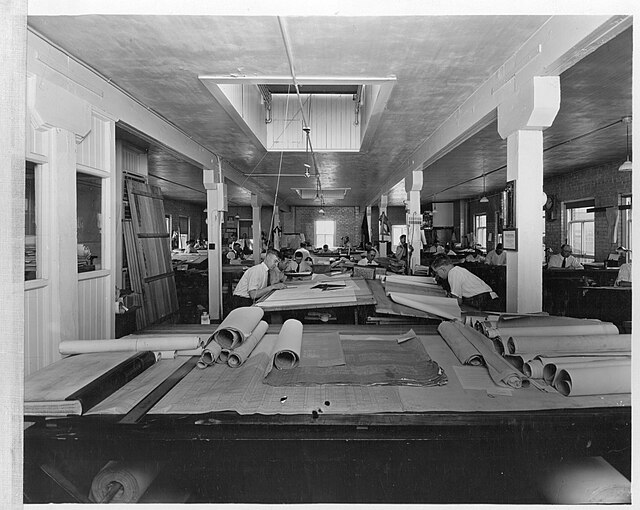
In architecture schools throughout the 20th century, students were required to produce drawings entirely by hand. Titles, annotations, dimensions: all hand lettered. The curriculum included lettering drills: repeated alphabets, uniform spacing, measured heights. The standard of quality was rigorous. A single poor letter could undermine the perceived professionalism of a drawing.
Late 20th Century Shift: CAD Becomes Dominant
As computing made its way into architecture practices (AutoCAD, MicroStation, etc.), human hands moved from drafting board to mouse. The ability to type: to choose font, size, weight, alignment, layer, etc. became part of the drawing workflow. The aesthetic of hand lettering (neat, uniform, simple) carried over, but digital tools allowed versioning, reuse, and modification.
Many firms hardened standards: approved font families, approved annotation sizes, approval of text styles across sheets. The function of lettering shifted partly from craft to specification. The design itself was the way to express yourself while the information conveyed was templatized.
What Has Changed and What Endures
There is change, but also much that carries forward.
What Has Changed
- Speed and flexibility: digital tools allow changes in annotation almost instantly; hand lettering could require erasing, redrawing, sometimes re-drafting an entire sheet.
- Variety of fonts: once limited to what one could hand draw, now thousands of fonts are available. Some mimic hand, some embrace modern minimalism, some provide expressive variation.
- Integration: text in drawings now often includes additional metadata (layers, more precise scaling, sometimes conditional text via BIM) rather than only being a visual note.
What Has Endured
- Clarity: letterforms still must be clear. Architects, permit reviewers, contractors all depend on legible text.
- Uniformity: within a drawing set there is still strong incentive for consistency of lettering: size, weight, spacing.
- Simplicity: many annotation fonts avoid decoration and flourish. The functional need to be read more than to be beautiful remains.
- Capital letters, or at least emphases closer to uppercase: because they tend to reduce ambiguity and improve readability.
The Future: Where Lettering Might Go Next
Looking ahead, a few possibilities seem likely.
Signature fonts tied to firm identity may become more common. As firms differentiate brands, the way their drawings look, even beyond layout or line weight, matters. Custom fonts, or firm-specific font systems, could evolve.
Variable fonts and parametric design may allow letterforms that adapt to scale, line weight, or context dynamically. Imagine an annotation that automatically uses heavier strokes or simpler forms when used at small sizes, lighter or more stylized when used large.
There’s also a renewed interest in the tactile and the hand-made. Some architects still teach hand lettering, not just for utility, but for training precision, aesthetic judgement, and as a way of slowing down. In presentations, sketches, and conceptual work the human touch of hand-lettered text can bring warmth and character.
Finally, as drawings are more often shared digitally (viewed on screens, tablets, via cloud, zoomed, annotated), legibility in digital display becomes as important as printed legibility. Lettering will need to account for screen rendering, anti-aliasing, scaling, zooming in other words, some of the same challenges of monument inscriptions, now in pixels.
Why Lettering Still Matters
It may feel like lettering is a small part of the drawing. But in a drawing set, the annotations are the voice. They tell what to see, how to read dimensions, clarify what lines mean. Poor lettering can lead to misunderstandings: misread dimensions, misinterpreted details, delays in construction. Good lettering reassures. It asserts that someone cared.
Moreover, lettering connects architects across time. When you look at an early 20th-century plan, or a mid-century drawing, you see a certain style. That style tells you about tools used, about what technologies were available, about what was valued in clarity, efficiency, craft. When you look at a modern BIM-based drawing, you see different constraints, different affordances, but often you still see echoes of that earlier discipline in the way text is placed, and in the way letterforms are chosen.
Architectural lettering is more than handwriting. It is a tradition shaped by centuries of inscription, by tools evolved for precision, by educational practices that demanded clarity. Even now, though digital fonts replace many of the old hands, many of the old rules persist: clarity, consistency, legibility.
As architecture continues to shift in scale, medium, toolset, and audience, the way architects write (by hand or by font) will remain a small but powerful indicator of how they see their work, how they care for communication, and how they connect with those who must build, examine, occupy, or preserve.