
The Development Timing Trap (Infographic)
Why Waiting Costs More Than Borrow Now
In commercial development, timing can feel like everything. Interest rates go up, interest rates go down, and every headline seems to suggest that the smart move is to wait for the right moment.
So let’s tell a simple story…
Once upon a time there were two developers looking at very similar projects. Same type of building. Same size. Same market. Same rough budget. The only real difference between them was a single decision.
The first developer looked at the market in 2023 and didn’t love what he saw. Interest rates were high. Construction financing wasn’t cheap. But the land worked, the demand was there, and the project penciled out well enough. So he decided to move forward anyway. Plans were drawn, permits were submitted, and construction began.
The second developer looked at the exact same environment and reached a different conclusion. Interest rates felt too high. Surely they would come down soon. Instead of starting right away, he decided to wait for the market to improve before breaking ground.
At the time, both decisions seemed reasonable. One developer accepted higher borrowing costs in exchange for getting started. The other chose patience, betting that lower interest rates would make the project more profitable.
Fast forward a few years.
Interest rates did shift. But so did everything else. Construction costs moved. Land values changed. Fees adjusted. And perhaps most importantly, one project was already open and producing revenue while the other was still getting ready to break ground.
What seemed like a simple financing decision turned into something much bigger.
This is the story of those two developers and the surprising math behind one of the most common assumptions in real estate development: that waiting for interest rates to fall is the safer move.
Part I: The Developer Who... Developed
Our story begins in January of 2023.
Land was still available at reasonable prices. Contractors were busy but not impossible to book. Cities were processing permits under the 2018 building code, and construction costs, while higher than before the pandemic, had not yet climbed to where many feared they would go.
So instead of waiting for the perfect conditions, he made a decision that many developers eventually have to make.
He moved forward.
Planning began in January 2023. The design team got to work. Engineers started their calculations. Site plans were prepared and submitted for review. The project moved through the city’s permitting process under the existing code cycle, which meant no additional cost from future building code changes.
By the time the plans were approved, the numbers looked like this.
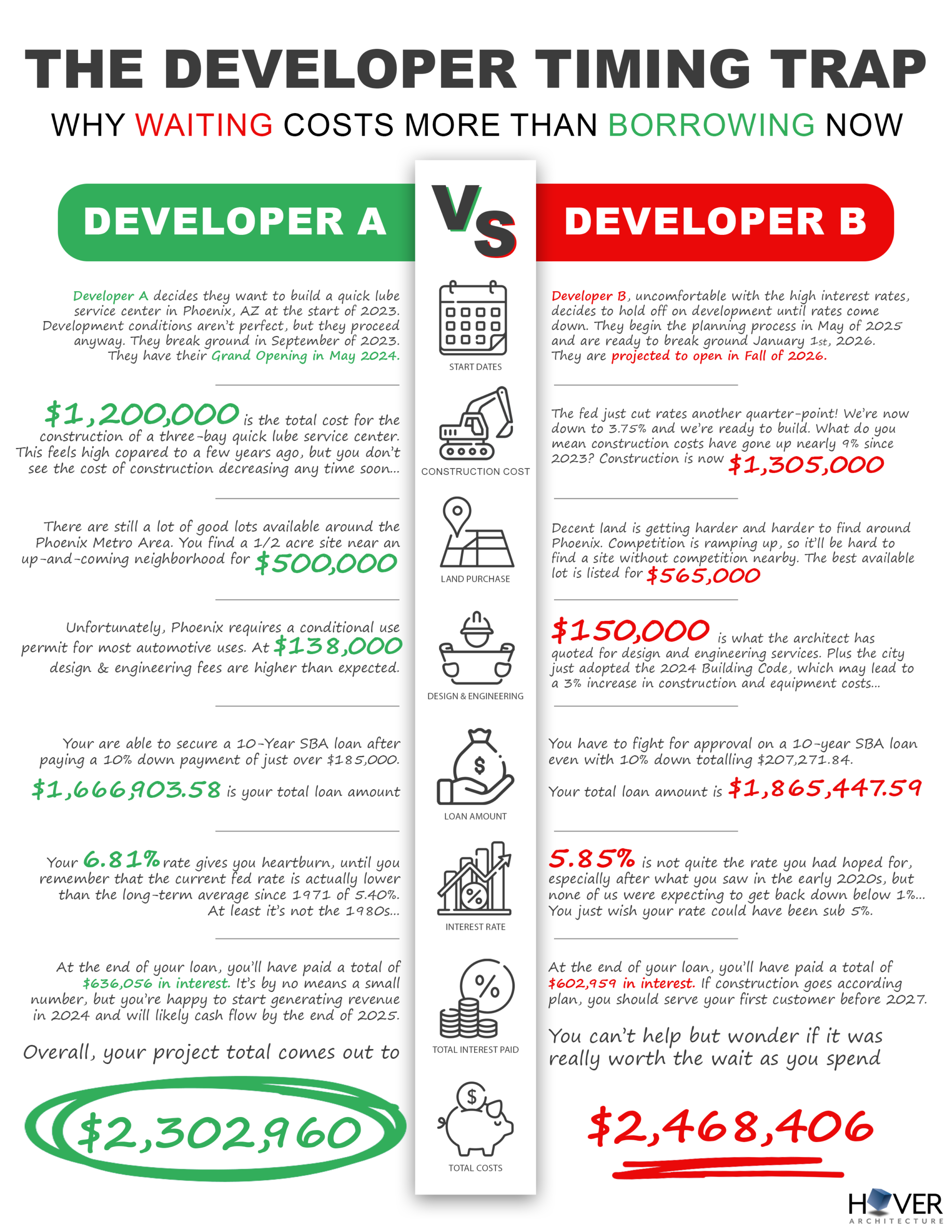
Construction would cost $1,200,000. The land for the half-acre site came in at $500,000. Utility connections were relatively modest. A 1-inch water tap would cost around $5,000 in Phoenix.
Permitting was straightforward as well. The city calculated a $5,064 permit fee, along with $4,051 in plan review fees, based on a review rate of $150 per hour. Design and engineering services for the project totaled $138,000, covering architecture, civil engineering, and the various consultants needed to bring the plans to life.
All together, the total development cost came to $1,852,115.
With plans approved and financing in place, construction began in September of 2023.
The developer secured an SBA loan at 6.81%, with the Federal Reserve rate sitting around 5.33% at the time. He put 10% down, investing $185,211 of his own capital into the project. The remaining $1.66 million was financed over a 10-year term, resulting in a monthly payment of about $19,191.
Over the life of the loan, the interest would add up to $636,056, bringing the total financing cost of the project to about $2.3 million.
Construction moved steadily through the winter and early spring.
And by May of 2024, just sixteen months after planning began, the building opened its doors.
The project was complete. The debt payments had begun. And most importantly, the business inside the building had started generating revenue.
The developer who moved forward in 2023 was no longer waiting for the market to change.
He was already open.
Part II: The Developer Who Waited
Not far away, another developer was studying the same kind of project.
He saw the same market conditions in 2023. The same rising interest rates. The same expensive construction loans. And he came to a different conclusion.
“This isn’t the right time,” he thought.
Surely interest rates would fall soon. And when they did, borrowing would be cheaper. The project would make more sense. The numbers would look better.
So instead of moving forward, he decided to wait.
Months passed. Eventually, the Federal Reserve began easing rates. By the time he felt comfortable moving forward, the lending environment had improved. SBA financing was now available around 5.85%, noticeably lower than the rates developers faced just a few years earlier.
Feeling confident that he had timed the market well, he began planning his project in May of 2025.
At first glance, the project looked almost identical to the one our first developer had built. It was the same type of building. The same size. Even the same half-acre parcel.
But time, as it turns out, rarely stands still in development.
The construction market had changed. The construction cost index had climbed from 189.8 to 206.6, pushing the building cost up to $1,306,217. What once cost $1.2 million to build now cost nearly 9% more.
Land had moved as well. The same half-acre parcel that once traded for $500,000 was now selling for about $562,500, a 12.5% increase.
Some things, of course, stayed the same. A 1-inch water tap in Phoenix still cost roughly $5,000. But in other markets the difference was far more dramatic. In parts of Denver, for example, the same connection had climbed to nearly $26,000!
Permitting costs had shifted slightly too. The building permit itself now cost $5,453, while plan review added another $4,362, partly because the city’s review rate had increased from $150 per hour to $195 per hour. Design and engineering services had crept upward as well, rising to $150,000.
Then there was the building code.
By the time this project was ready for review, the city had adopted the 2024 International Building Code. The updates weren’t dramatic, but they did require small adjustments to the building’s design and construction. Those changes added about 3% to the construction budget, or roughly $39,000 in additional costs.
Piece by piece, the numbers grew.
When everything was added together, the project’s total development cost came to $2,072,718. Adjusted for inflation across the development timeline, the effective project cost was closer to $2,197,082.
Still, the developer had accomplished what he set out to do. Interest rates were lower.
He put down 10%, investing $207,272 of his own capital. The remaining $1.86 million was financed with an SBA loan at 5.85%, lower than the rate our first developer secured years earlier. Over the life of the loan, the interest would total about $602,959.
His monthly loan payment would be $20,570.
Construction finally began in January of 2026, nearly three years after the first developer had started planning his project.
If everything went according to plan, the building would open in September of 2026.
By then, the developer who had started back in 2023 would have been open for more than two years and cash flow positive.
Part III: The Developer Who Waited Just a Little Longer
Our third developer watched the same market as the second.
He saw interest rates begin to fall. He saw projects starting again. And he believed the logic made sense. Waiting had worked for others, so why rush?
After all, what difference could a few more months really make?
Instead of starting planning in May of 2025, he waited just a bit longer and began in November of 2025. Six months didn’t seem like much time in the world of development. Permits alone can take that long.
But markets move even when projects don’t.
By the time his team began putting numbers together, construction costs had crept up again. The construction cost index had been expected to rise to around 213.5, pushing the building cost to $1,349,842. The same building that cost $1.2 million to construct just a few years earlier was now nearly $150,000 more expensive.
Land followed the same path. That half-acre site, once purchased for $500,000, was now closer to $575,000.
Design and engineering costs ticked upward as well, climbing to about $156,000. Permitting costs stayed relatively similar, though slightly higher as fees adjusted over time. And like the second developer, this project also fell under the 2024 International Building Code, adding roughly 3% in construction-related requirements.
When all the numbers were tallied, the total development cost came to roughly $2.13 million, or about $2.29 million when adjusted for inflation.
Financing did improve slightly. The SBA rate dropped to about 5.80%, a modest improvement from the previous developer’s loan.
But the savings were smaller than expected.
Even with the slightly lower rate, the larger loan meant the project carried a monthly payment of $21,139, higher than either of the previous developers. Over the life of the loan, the project would pay about $615,000 in interest, bringing the total financing cost to roughly $2.54 million.
Construction was not expected to begin until July of 2026, with a projected opening in March of 2027.
By that point, the first developer from our story would have been open for nearly three years.
And all because of a decision to wait just a little longer.
The Moral of Our Story
And so our little development fairytale comes to an end.
Three developers. Three very reasonable decisions. And three very different outcomes.
The first developer looked at 2023 and decided the market was good enough. Interest rates were higher than he liked, but the project worked, so he moved forward. By May of 2024, his building was open, his business was operating, and his loan payments were already being covered by revenue.
The second developer waited patiently for interest rates to fall. Eventually they did. He secured a lower rate and began construction in 2026. But by then construction costs had risen, land had appreciated, and new code requirements had quietly added to the budget. His total project cost ended up hundreds of thousands of dollars higher than the developer who started earlier.
The third developer waited just a little longer than that.
Six months.
Surely six months couldn’t make much of a difference.
But construction costs kept moving. Land prices continued to climb. Design and engineering costs increased. By the time his project would finally break ground in mid-2026, the total development cost would rise again, and his monthly loan payment was now the highest of the three.
And perhaps that’s the real lesson of this story.
In development, people spend a lot of time trying to time interest rates. But interest rates are only one piece of the equation. While developers wait for the “perfect” financing environment, everything else in the project keeps moving. Construction costs rise. Land values shift. Fees change. Codes evolve. And the market keeps building around you.
Meanwhile, the developer who started earlier is already open, already generating revenue, and already working on the next site.
It turns out the most expensive thing in development isn’t always high interest rates.
Sometimes it’s waiting.
So if you’re sitting on a site, running the numbers, and wondering if the market will look better next year, you’re not alone. Developers ask that question every day.
But if you’re ready to stop waiting and start building, we’d love to talk.
Reach out to Hover Architecture, and let’s start planning your next project. After all, every development story has to start somewhere.